


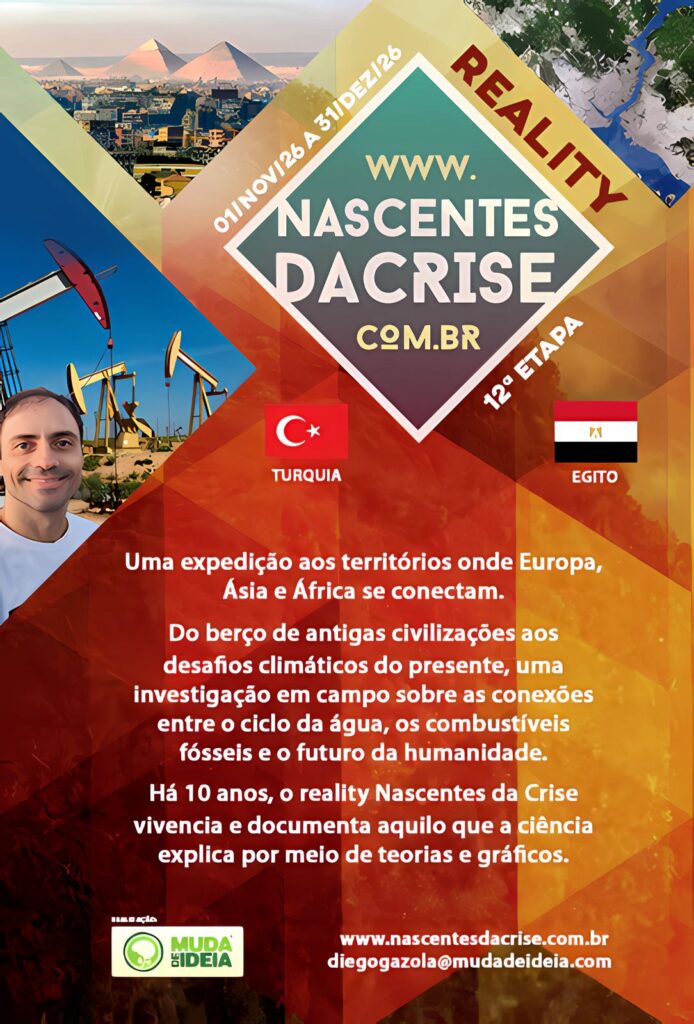
An expedition to the territories where Europe, Asia and Africa meet. From the cradle of ancient civilizations to today's climate challenges, a field investigation into the connections between the water cycle, fossil fuels and the future of humanity.
It is in this context that documentary maker and journalist Diego Gazola, from Varginha (Brazil), carries out the 12th stage of Nascentes da Crise, an independent audiovisual project created in 2015 that, for over a decade, has already traveled through 14 countries to investigate and document the planet's social and environmental transformations.
This time, the expedition begins in Turkey, a strategic territory linking Europe and Asia and standing at the confluence with the African continent. Besides documentary research, Gazola will provide journalistic coverage of COP31, the 31st United Nations Climate Change Conference. He will then continue to Egypt, where he will investigate the historical relationship between water and the development of the civilizations that flourished along the banks of the Nile.
Turkey: between continents, energy and geopolitics
The expedition begins in Turkey, a country that holds a strategic position between Europe and Asia and that has historically connected different civilizations, trade routes and international energy corridors.
The aim is to investigate how historical processes of human settlement, geographical features and contemporary challenges relate to water availability.
The region offers a privileged perspective for understanding some of the great issues of the 21st century, such as water security, the dependence on fossil fuels, the energy transition and the impacts of climate change.
From field experience to global debate: covering COP31
During his time in Turkey, Diego Gazola will also provide journalistic coverage of COP31, the 31st United Nations Climate Change Conference, between November 9 and 20.
The event brings together representatives of governments, international organizations, scientists, civil society movements and the press from different countries to discuss and negotiate the paths of global climate cooperation and, consequently, the future of humanity.
The coverage, produced for the printed newspaper Gazeta de Varginha, aims to bring the public closer to the Conference's backstage, its main debates and international negotiations, connecting the decisions made in multilateral talks to the realities observed during the expedition.
This will be another time Gazola covers the UN climate conferences. The documentary maker has already followed five previous editions: COP15 in Denmark (2009); COP16 in Mexico (2010); COP17 in South Africa (2011); COP21 in France (2015); and COP30 in Brazil (2025).
The goal is to build a bridge between the lived experience of field research and the major international debates on the planet's climate future.
Egypt: the Nile and the civilization that learned to live with the waters
After Turkey, the expedition continues to Egypt. The plan is to follow the entire course of the Nile in Egyptian territory, from Abu Simbel, near the border with Sudan, to its mouth on the Mediterranean, in the delta region between Alexandria and Damietta. That is, between the Rosetta branch (to the west) and the Damietta branch (to the east).
More than following a river geographically, the expedition intends to investigate the historical relationship between water availability, the organization of societies and the development of the civilizations that flourished on its banks.
It was around the waters of the Nile that one of humanity's most extraordinary civilizations developed knowledge of engineering, mathematics, astronomy, agriculture, architecture and water resource management. The pyramids, the temples, the irrigation systems and the records of flood cycles show how knowledge of water dynamics was fundamental to the organization of that society.
For millennia, the Nile's annual floods fertilized farmland and set the rhythm of food production and Egyptian economic life. It is a relationship between nature and society that offers important references for reflecting on today's challenges of water security, land occupation and climate change.
The journey will also make it possible to observe changes in the river's dynamics, the impacts of large infrastructure works, the importance of the Aswan Dam and the challenges of the shared management of the waters of a river basin that crosses several African countries, from its sources in Uganda, Rwanda and Ethiopia.
The investigation starts from a fundamental question: what can we learn in the 21st century from civilizations that understood the importance of natural cycles in building their prosperous social and economic organization?
12 years translating and experiencing what science explains
Created in 2015, Nascentes da Crise was born with the aim of turning complex scientific topics into audiovisual experiences accessible to the general public. Instead of presenting only theories, statistics and charts, the project seeks to experience phenomena directly in the territories where they happen, bringing viewers closer to the environmental, social and geopolitical realities that help explain the planet's transformations.
Throughout its trajectory, the series has traveled through different regions of the world, investigating the water cycle, the relationships between climate and territory, the exploitation of natural resources and the challenges of the energy transition.
In a reality-documentary format, the project also shares real-time research posts on Instagram, Facebook and X (Twitter), using the hashtag #nascentesdacrise to engage and interact with the public during the expeditions.
In the 12th stage, the meeting of Turkey and Egypt broadens our view of a region fundamental to understanding the relationship between past and future: territories that witnessed the birth of civilizations and that today are at the center of some of humanity's great environmental, economic and geopolitical issues.
About Nascentes da Crise
Created in 2015, Nascentes da Crise is an independent reality-documentary that investigates socio-environmental crises, the geopolitics of natural resources and the effects of climate change around the world. Its methodology combines research, international expeditions, hands-on experiences and audiovisual production, bringing the public closer to scientific topics through documentary narratives.
Over 12 stages, the project has built an international trajectory of investigation, with content produced in several countries and films that address the connections between the water cycle, climate change, the exploitation of natural resources and the future of humanity.
Those interested in supporting the project can find the donation channel on the website.
All of the series' content is available free of charge in Portuguese, Spanish and English on the official website: https://nascentesdacrise.com.br
Who is Diego Gazola
Diego Gazola is a journalist, documentary maker, entrepreneur and socio-environmental researcher from Varginha (Minas Gerais, Brazil). With more than two decades of professional experience, he has traveled to every Brazilian state and about 40 countries, producing journalistic content, documentaries and 18 printed travel guides about cities and regions of Brazil and the world.
He is the creator and producer of the series Nascentes da Crise, an entrepreneur with the consultancy Muda de Ideia and the creator of the Festival Virada Varginha. He has taken part in five United Nations Climate Change Conferences and was co-host of the program Expedición RCN Brasil, on the Colombian television network RCN.
To follow the expedition's updates and the COP31 coverage: @diegogazola and #nascentesdacrise on social media.